// RadioSonic by SigPro Labs
A complete digital signal processing curriculum paired directly with a custom audio board. Augment algorithm simulations by implementing them on real hardware.
To provide the best experience for our customers, our first run of hardware is bundled with course enrollment only.
// open source hardware · hands-on DSP · free shipping* //
*Orders $49+, continental US only
RadioSonic Signal Processing Platform · Rev 3
// platform
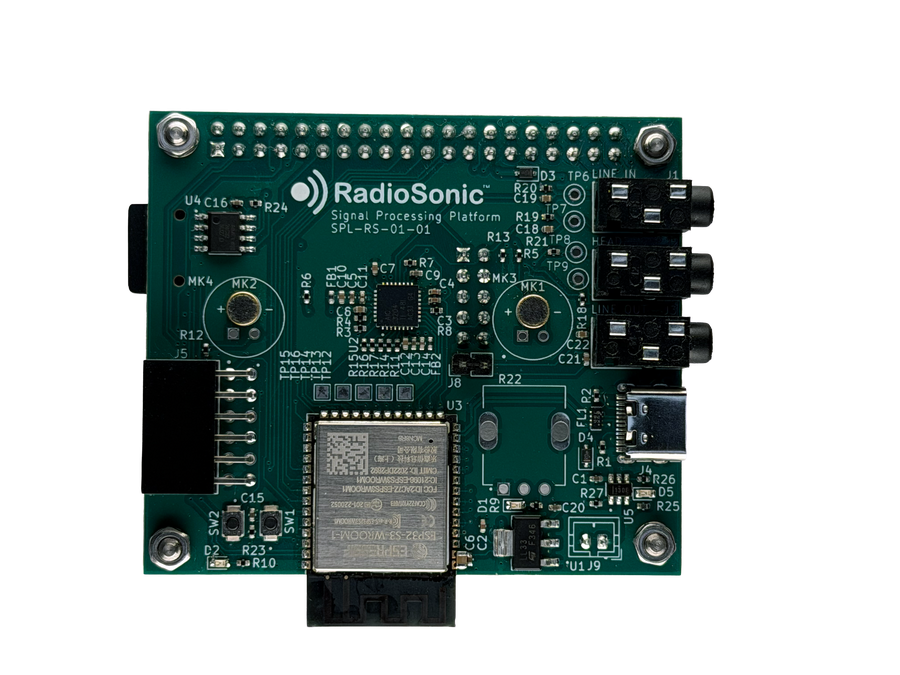
Onboard mics at 30 mm spacing, expandable to 6 via codec port, for beamforming and angle-of-arrival demos.
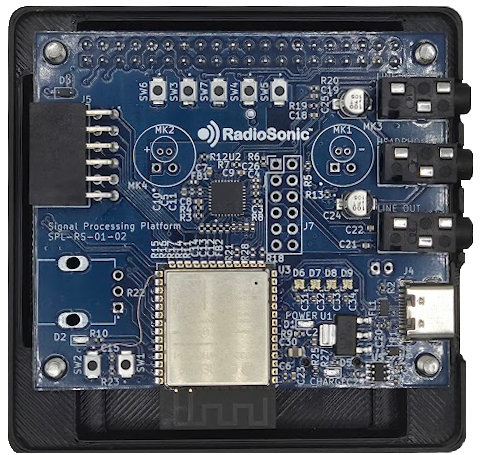
TLV320AIC3204 codec with stereo line in, line out, and headphone out. Real-time DMA ping-pong buffering between dual 24-bit ADC in and dual 24-bit DAC out.
DMA framework included. Lessons slot in as self-contained C include files, with no low-level driver work required, and no programming expertise required to run.
Post-processing in Python. Notebooks allow waveform processing for curious students; no programming expertise required to run them.
Creative approach for wavelength-consistent SDR-style experiments using audio-frequency propagation. Courses in 2027.
Ample memory for audio recording, long filter pipelines, and buffering experiments. Wi-Fi enables SD card data transfer to PC.
// firmware
The firmware provides real-time DMA streaming between dual 24-bit ADC and DAC. Each lesson is a drop-in processing block where students work at the algorithm level, not the driver level. You will see and work with the C that runs on the board, but no prior C experience is required: these are signal processing courses, not embedded programming courses. The topics below span current and future courses.
// Direct Form I biquad: y[n] = b0·x[n] + b1·x[n-1] + b2·x[n-2] // - a1·y[n-1] - a2·y[n-2] // Coefficients loaded from shared state; ch 0 = L, ch 1 = R. const float b0 = g_state.biquad.b0, b1 = g_state.biquad.b1, b2 = g_state.biquad.b2; const float a1 = g_state.biquad.a1, a2 = g_state.biquad.a2; const float k = g_state.biquad.k; // overall gain scalar // Left channel: apply difference equation, then shift delay lines yL = b0*xL + b1*g_df1.x1[0] + b2*g_df1.x2[0] - a1*g_df1.y1[0] - a2*g_df1.y2[0]; g_df1.x2[0] = g_df1.x1[0]; g_df1.x1[0] = xL; // x[n-2] <- x[n-1] <- x[n] g_df1.y2[0] = g_df1.y1[0]; g_df1.y1[0] = yL; // y[n-2] <- y[n-1] <- y[n] yL *= k; // Right channel: identical structure, independent delay lines yR = b0*xR + b1*g_df1.x1[1] + b2*g_df1.x2[1] - a1*g_df1.y1[1] - a2*g_df1.y2[1]; g_df1.x2[1] = g_df1.x1[1]; g_df1.x1[1] = xR; g_df1.y2[1] = g_df1.y1[1]; g_df1.y1[1] = yR; yR *= k;
// courses
Built for working engineers and students who have completed an undergraduate Signals and Systems course and want to go deeper, implementing filters at the core functional level on real hardware, not through library calls.
Next cohort starts Tuesday, October 13, 2026.
Early Bird registration through September 11, 2026. Registration closes September 30, 2026.
Filter theory usually arrives as a wall of transfer functions and pole-zero plots, and it stays abstract right up to the moment you can actually apply it to real signals. This course closes that gap. Over eight weeks you will design filters in Python, compile them to real hardware, and hear what your design choices do to live audio.
Four modules released biweekly over eight weeks. Each module opens with curated pre-recorded video lessons you work through at your own pace, and closes with a live session for Q&A and open discussion with the instructors. Between sessions the instructors stay accessible through the online learning platform, where ongoing Q&A is shared with the instructors and the rest of the class.
Online exercises cover correlation, convolution, FIR design (lowpass, highpass, bandpass), and IIR biquads, all operating on real audio passing through the board. marimo notebooks accompany each topic for students who want to push further.
No prior C or Python coding experience is required. This is a signal processing course, not a programming or embedded design course. That said, nothing is hidden: you get full visibility into the underlying C and Python implementations, and you see the complete path from source code through compilation to running hardware, using the same development tools practicing engineers use.
RadioSonic hardware is required and is not included in the course price. The board ($49) and the cable kit (free with any course) are added to your cart automatically at checkout. Returning students who already have hardware can remove them and pay for the course alone.
Next cohort start date: to be announced (2027)
A 3 kHz tone in air has a wavelength of about 11 centimeters. A 2.4 GHz Wi-Fi signal has a wavelength of about 12.5 centimeters. Nearly identical, which means a room full of sound at audio frequencies scatters, reflects and fades the same way a room full of Wi-Fi does, just a million times slower.
That is the premise behind RF in Slow Motion: replace the speed of light with the speed of sound and modern waveforms become something you can watch, and hear, happen. With that we can demonstrate how modern algorithms deal with multipath, Doppler and fading, using the channel as the room we are in.
You will work through the real signal chain: carrier recovery, timing recovery, equalization, quadrature correction and automatic gain control, applied to OFDM and QAM waveforms running in real time on RadioSonic. You will apply crest-factor reduction to lower the peak to average power ratio of transmit waveforms. The full link runs on the board itself, not on your laptop. GNU Radio is also used for additional visualization and post-processing, so you can pull any point in the chain apart in a framework you will use again on RF hardware.
Same algorithms, same architecture. Slowing everything down is what makes it work: with orders of magnitude more processing time per symbol, a low-cost embedded processor can run the same algorithms that demand expensive silicon at RF rates.
// already enrolled
Student login
Log in to Moodle to continue where you left off.
// hardware
All RadioSonic hardware is designed to be affordable, durable, and immediately useful in the classroom or at a lab bench.
Hardware is available for purchase to the general public after the conclusion of our first course. Board and cable kit are included automatically when you enroll in a course. Boards for the first cohort ship by the end of September 2026, so your kit arrives before the course opens on 13 October.
ESP32-S3 board with TLV320AIC3204 codec, onboard microphones, Wi-Fi, USB, Raspberry Pi HAT form factor, and RadioSonic firmware.
Adds two electret condenser microphones. Stack up to two expansion boards per RadioSonic for a full 6-mic beamforming array.
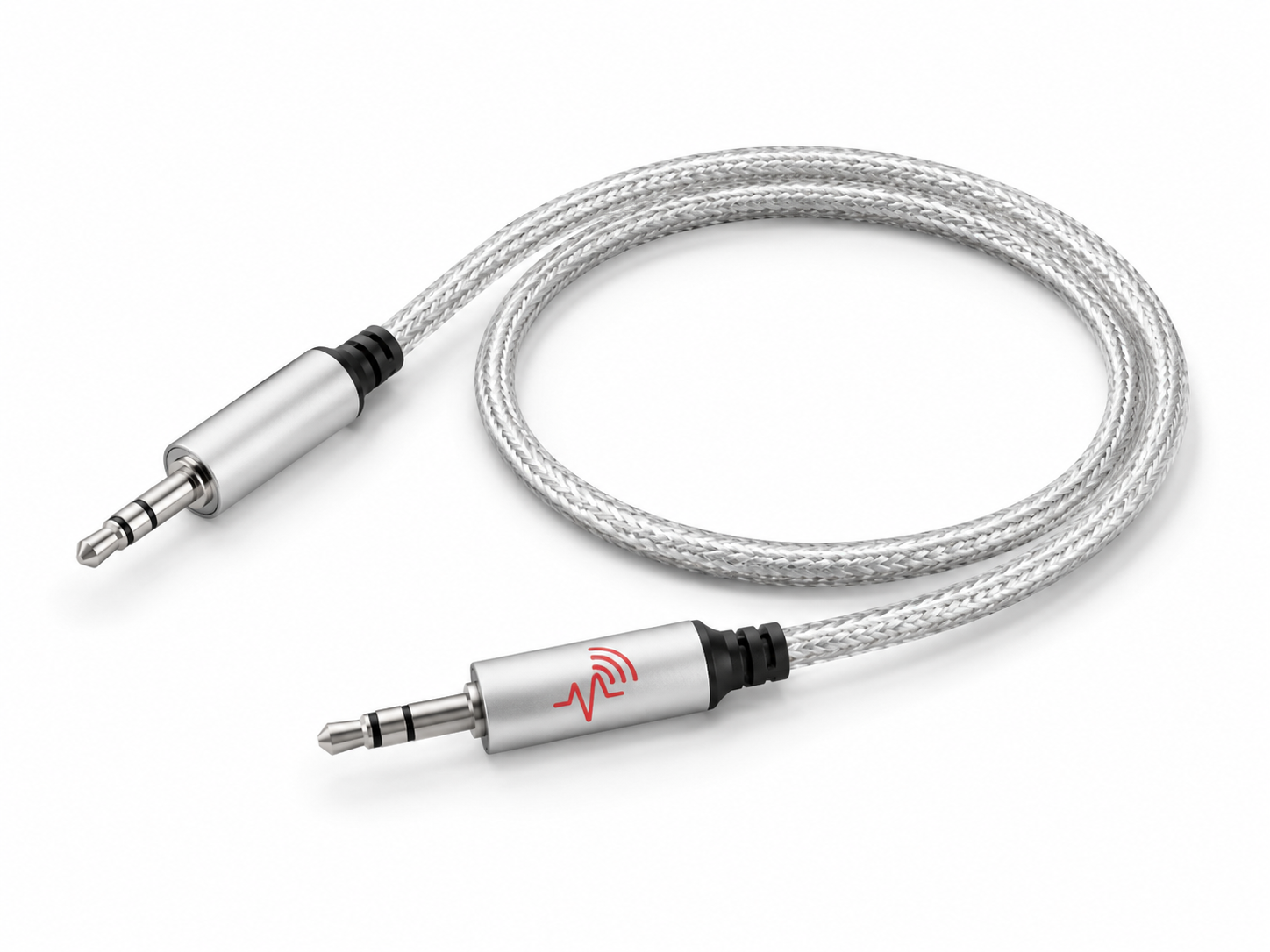
Two 3.5 mm stereo cables, one USB-C to USB-A cable, one USB-A female to USB-C adapter. All the cables you need for connecting external audio sources and sinks.
Low-profile ABS snap-on enclosure with cutouts for all connectors. Keeps the board safe in a backpack or lab kit.
30-Day Returns: Hardware. This policy applies to physical hardware products only and does not cover course registrations or training fees. Contact us within 30 days of delivery for a return authorization (RMA) number before shipping anything back. If your item is defective, we'll cover return shipping and send a replacement at no cost to you. For any other reason, return it in resalable condition for a full refund of the purchase price; return shipping is at your expense.
// about sigpro labs
SigPro Labs designs affordable hardware platforms that let students and working engineers learn signal processing the way it's actually done in industry: by writing filter code, watching audio waveforms move in real time, and seeing concepts like Fourier analysis, convolution, and beamforming on a scope rather than just in a textbook.
RadioSonic is our first product. It moves the propagation phenomena of wireless communications down into the acoustic band, so wavelength-dependent effects like multipath, Doppler, and angle of arrival appear in slow motion on a board you can hold in your hand.
We're a two-person team of long-time DSP engineers and educators based in the US.
Learn more about SigPro Labs →// get in touch
Course enrollment, hardware orders, partnerships, or anything else. We respond within one business day.
Join engineers and students using RadioSonic to build signal processing skills useful for real-world applications.